Control de vapor (Passive Purple)
What is a vapour control layer, and why does it sit on the warm side?
A vapour control layer (VCL) is a material that limits the movement of water vapour from the heated interior of a building into the structure. It does not aim to block vapour absolutely; it regulates the rate at which vapour crosses into the construction, so the fabric stays dry enough to work.
In the UK climate it goes on the warm side of the insulation — the room side. In a wall that means between the insulation and the plaster or lining; in a warm flat roof, on the deck below the insulation. Put it on the cold side and it traps moisture exactly where you least want it: against a cold surface with no drying path.
The failure mode has a name, interstitial condensation, and its characteristic is that nobody sees it happen. Insulation gets damp and loses performance. Timber studs, joists and roof decks stay wet long enough to decay. Mould grows behind finishes. By the time staining, blown plaster or a musty smell appears on the surface, the damage inside the build-up is usually well advanced. Our fuller introduction is What is a vapour control layer? VCL explained.

Does my project actually need one?
The rule of thumb is short: change the insulation, and you have to think about vapour. Adding insulation changes the temperature profile of a construction, which moves the dew point and makes surfaces that used to run warm run cold. The situations where a VCL is either essential or strongly advised are consistent.
Insulation upgrades of any kind
Roof, wall or floor. The old inner surfaces become colder than they were, and condensation risk rises with them. A warm-side VCL is the standard protection.
Timber frame
Timber frame walls depend on staying dry. UK practice places a VCL on the warm side of the frame to protect both the structure and the insulation between the studs.
Warm flat roofs
A VCL below the insulation stops moisture reaching the cold deck or the underside of the waterproofing, where it has no route out.
Internal wall insulation
Insulating a solid wall from the inside makes the original masonry considerably colder. Without vapour control on the warm side, moisture migrates in and condenses against it — see VCL for internal wall insulation.
A redecoration with no change to the insulation generally does not need a VCL added. Everything else does. The longer treatment, with the UK-specific answers, is in Do I need a vapour barrier? A UK guide — and if the layer was missed on a build already under way, My builder forgot the vapour control layer covers the recovery.
Why is airtightness the bigger half of vapour control?
Moisture reaches a construction two ways, and they are nothing like equal.
Air movement is bulk flow through gaps, cracks and poorly sealed junctions, driven by wind and pressure differences. It carries large volumes of moisture, quickly. Vapour diffusion is individual water molecules moving slowly through materials, driven by humidity differences. It carries very little by comparison.
A single unsealed gap can deposit more condensation in a cold roof void over one winter than diffusion through the entire ceiling. That is why a vapour control strategy which is only about diffusion — a sheet with a good sd value, taped optimistically — misses most of the problem. The dominant transport route is air, and closing it is airtightness work.
This is the reason we treat the two as one layer rather than two. Passive Purple is the airtight layer and the vapour control layer in a single liquid-applied membrane, so the surface that stops the air is the same surface that regulates the vapour, with nothing between them to fail. If your priority is the air test rather than the moisture, the same system is described from that side on our internal airtightness page.

Will an airtight vapour control layer trap moisture in the wall?
Not if the layer can open when the fabric needs to dry. This is where a liquid membrane differs from polythene in a way that matters on real buildings.
A traditional polythene VCL has one fixed behaviour: closed to vapour, permanently, in both directions. In winter that protects the construction. But it also blocks drying — so if moisture gets into the fabric from construction water, a leak, or an old solid wall's stored moisture, the sheet stops it drying back into the room. On retrofit that is precisely the wrong property, because an insulated solid wall runs colder and dries more slowly than it did before, exactly when it most needs an inward drying path.
Passive Purple stays airtight at all times — the air barrier never switches off — while remaining vapour open when the construction needs to release moisture. The building gets a continuous air barrier and a drying route in one coating system. The physics, and the objections we hear most often, are set out in Will airtight paint trap moisture? and the test data in Waterproof, watertight and vapour-intelligent.
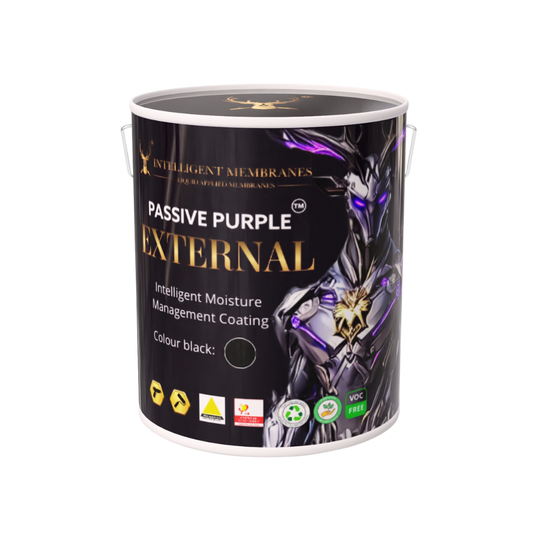
Where the membrane goes on the outer face instead — overcladding, external wall insulation, re-cladding — Passive Purple External is vapour open at sd 0.62 m to EN ISO 12572 under Kiwa BDA Agrément BAW-21-214-P-A-UK, so the wall still dries outwards while the film resists driving rain at water permeability Class W3.
One thing we do not do is tell you what the risk is in your particular build-up. Interstitial condensation risk depends on the construction, the insulation position and the exposure, and it is modelled rather than assumed. We do not carry out condensation risk analysis ourselves — on most projects it is produced by the insulation manufacturer, and several of them provide it free with their system. We have listed those free services on our condensation risk analysis page.
Why a liquid VCL rather than a sheet?
A sheet VCL works exactly as well as its weakest tape joint. Every socket, pipe, joist penetration, reveal and awkward corner is a lap or a collar, and each one depends on the substrate being clean and dry at the moment it was rolled down. On a renovation with uneven surfaces, sheet is slow to detail and easy to detail badly. Once the lining is on, none of it can be inspected.
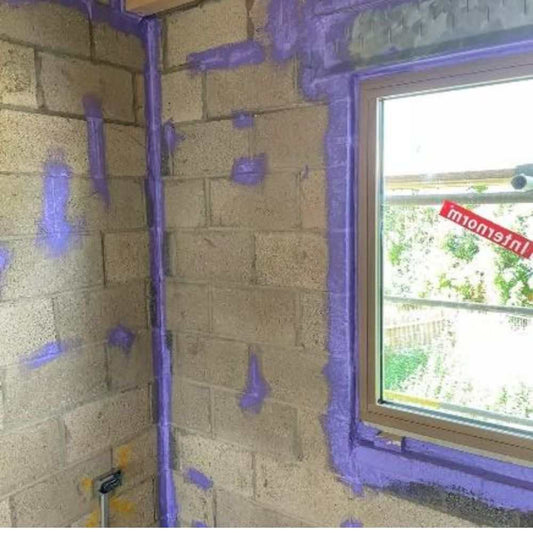
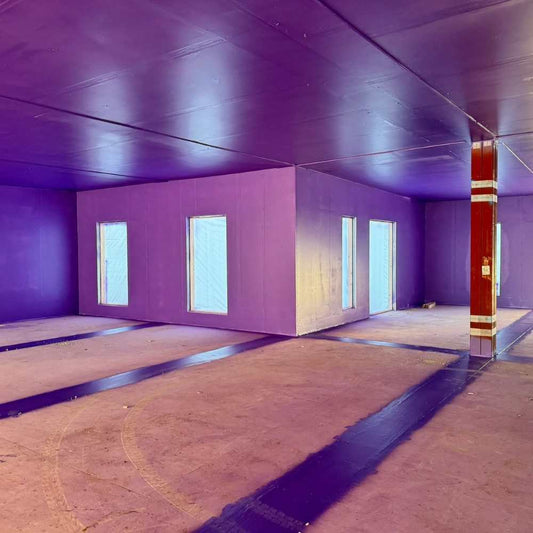
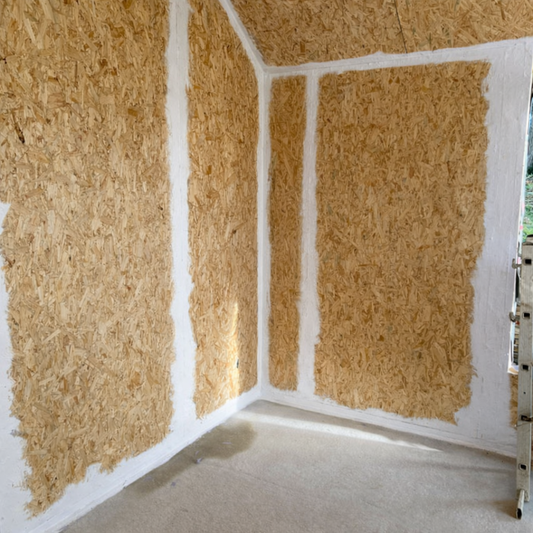
A liquid membrane cannot be torn, stapled through or left flapping at a lap, because there are no laps. It bonds directly to blockwork, concrete, timber, OSB and plasterboard, cures flexible so it moves with the building, and the coloured finish doubles as quality control: if the wall is purple, the wall is coated. Complex geometry stops being a series of special details and becomes part of the surface being sprayed.
It is a two-coat system, always. The certified performance depends on reaching the specified dry film thickness, and that takes two full coats — the first evens out the substrate's suction, the second builds thickness and closes any pinholes. Visual coverage is not the same as film thickness, and skipping the second coat is the single most common cause of a disappointing result. The practicalities are in the application FAQ, and the surface preparation in how to prep a wall for an airtight coating.

Which products form the vapour control layer?
Passive Purple (11.4 kg, spray or roller)
- Passivhaus Institut certified Class A (phA)
- Air permeability 0.02 (±0.002) m³/(h·m²) at 50 Pa to EN 12114, tested as a system including its connections
- Air permeance 0.02 L/s·m² at 75 Pa, ICC-ES ESR-4715
- Elongation 219%, tensile 17 N/50mm (BBRI, EN 12311-1)
- Emissions class M1, valid to 01.09.2027 (Rakennustieto)
- Coverage 0.8–1.0 kg/m² on OSB and plasterboard
The internal airtight and vapour control layer in one membrane, applied to the structure behind plaster or lining.
Passive Purple External (10 kg, spray or roller)
- sd 0.62 m to EN ISO 12572 (Kiwa BDA Agrément BAW-21-214-P-A-UK)
- EN 13501-1 Class B-s1,d0 (PAVUS PK1-01-20-065-E-1)
- Water permeability Class W3
- Crack bridging Class A3 at 23 °C, A4 at −10 °C
- Passivhaus class phB, 0.16 m³/(hm²), component ID 2380as00
- Coverage 1.0–1.2 kg/m² on blockwork and brickwork
Vapour open on the outer face, for overcladding, external wall insulation and re-cladding.
Passive Purple Brush (6.9 kg)
- Same Passive Purple chemistry as the sprayed field coat
- Detail grade for joist ends, perimeters, reveals and penetrations
The detail and the field become one material, at the junctions where a sheet system relies on an adhesive.
Airtight White
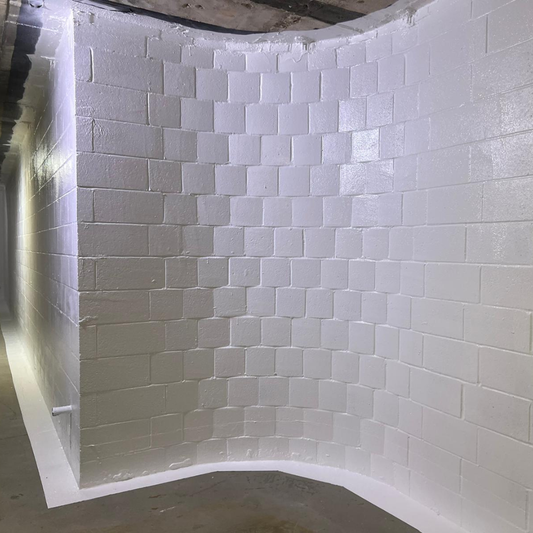
The same liquid VCL approach where the layer is left on show or painted over rather than hidden behind a lining.
Primers
- IM Primer — 0.15–0.25 kg/m², dense and smooth backgrounds
- Lime Prime — 0.15–0.25 kg/m², lime and porous backgrounds
- Supergrip Primer — 0.2–0.3 kg/m², key for plaster over the cured membrane
Substrate-by-substrate selection is on our primers page.
Adhesion, BS EN ISO 4624
- Concrete 1.02 N/mm²
- Plywood 0.75 N/mm²
- OSB 0.42 N/mm²
- Gypsum sheathing 0.24 N/mm²
- Wood fibre 0.04 N/mm²
Published in full, including the low figures, because those are the honest reason to prime.
How much material should we allow?
| Product | Substrate | Coverage |
|---|---|---|
| Passive Purple | OSB and plasterboard | 0.8–1.0 kg/m² |
| Passive Purple External | Blockwork and brickwork | 1.0–1.2 kg/m² |
| Supergrip Primer | Cured membrane before plaster; smooth ICF and concrete | 0.2–0.3 kg/m² |
| Lime Prime | Lime, porous and dusty backgrounds | 0.15–0.25 kg/m² |
| IM Primer | Dense and smooth backgrounds | 0.15–0.25 kg/m² |
Figures are per coat and vary with substrate porosity, application method and the specified film thickness. Full figures for every product are on the application and coverage rates page.
Has it been proved?
The membrane's certification is measured as a system rather than as a sheet of material, which is the distinction that matters for a layer whose job is continuity. Passive Purple is certified by the Passivhaus Institut as Class A (phA), with an air permeability of 0.02 (±0.002) m³/(h·m²) at 50 Pa to EN 12114 — one fifth of the phA limit of ≤0.10 — and the test included its connections, not just the film. Ghent University independently confirmed 0.019. The connection results themselves are published: membrane-to-concrete 0.01, membrane-to-membrane 0.02, membrane-to-OSB 0.03 m³/(h·m²) at 50 Pa.
On buildings, we returned 0.078 ACH at Wester Hailes High School, Edinburgh — a whole-building pre-test after our works, measured by EDP Building Sciences to ATTMA TSL4 in November 2025 against a 0.6 design target. Everton Heath Primary School returned 0.3 ACH. On existing housing, the membrane has been applied directly over old brickwork as a continuous seal rather than as a lining behind battens, and used to make a warm roof retrofit airtight and vapour controlled in one operation.
Wester Hailes — 0.078 ACH Retrofit sealing on brickwork Warm roof retrofit, Tottenham Ampthill barn conversion

See it on site
The 360° tours let you walk completed applications and look at how the layer was taken through reveals, joist ends and penetrations. The video channel shows the spray and detailing sequence, which is usually what answers the question of how a liquid VCL handles a junction a sheet would struggle with.
360° site tours Application videos Technical details and drawings

Frequently asked questions
Which side of the insulation does the vapour control layer go?
The warm side — the room side of the insulation in walls and roofs in the UK climate. On the cold side it traps moisture against a cold surface with no drying path.
Does an airtight VCL stop the wall breathing?
A polythene sheet is vapour-closed permanently in both directions. Passive Purple stays airtight at all times but remains vapour open when the fabric needs to release moisture, so the construction keeps an inward drying path. Passive Purple External is vapour open at sd 0.62 m to EN ISO 12572.
Do you carry out condensation risk analysis?
No. Interstitial condensation risk is modelled for the specific build-up, and on most projects the insulation manufacturer produces it — several free with their system. We have listed those services on our condensation risk analysis page.
Is a liquid VCL as good as sheet at vapour control?
It forms a continuous, bonded layer with no laps or taped joints to fail, which is where sheet systems usually lose performance in practice. It also carries the airtightness function in the same film, closing the route that moves most of the moisture.
Can we plaster over it?
Yes, once fully cured, with Supergrip Primer first to give the plaster or dot-and-dab adhesive a key on the smooth membrane. Supergrip covers 0.2–0.3 kg/m².
What if the VCL was left out and the build is already under way?
A liquid membrane can often be applied over the existing substrate without stripping the build-up back, which is the usual recovery route. Our article on a missed vapour control layer sets out the options.
Two ways to work with us on vapour control
Supply. Buy the membrane, primers, tapes and sealants and apply them with your own operatives or your contractor.
Supply and install. We apply the system ourselves, and on projects we install we guarantee 0.6 ACH or lower. Send the build-up, the substrates and the insulation position, and we will come back with an approach and a price.
Supply — view the range Supply and install — talk to usShop Vapour Control Layer Products
-
Oferta
-
Pintura Passive Purple - Control de vapor, hermética y a prueba de humo (11,4 kg) - Aplicación con pulverizador o rodillo
Short spec • 11.4 kg
Licenciatura en Administración de EmpresasOferta -
Sellador hermético Passivhaus - 600 ml
Short spec • 840 g
Licenciatura en Administración de EmpresasOferta