Gases subterráneos
How does radon actually get into a building?
Radon is a naturally occurring radioactive gas formed when uranium in soil, rock and groundwater decays. It is invisible, odourless and tasteless, so it can be present without anyone noticing, and is identified only through specialist testing. Outdoors it disperses harmlessly; indoors it can accumulate. Long-term exposure is recognised as the UK's second-largest cause of lung cancer after smoking.
It enters from the ground beneath the building, through cracks in concrete floors, gaps around service penetrations, joints between slabs and walls, and construction joints and cavities. The mechanism is the ordinary physics of a heated building: as warm air rises inside, it creates a slight negative pressure at low level, and that pressure difference draws gases out of the ground. This is the stack effect, and it is why ground gas is an air-movement problem before it is a chemistry problem.
So the entry points are exactly the air leakage paths a blower door test would find: floor-to-wall junctions, service penetrations and poorly sealed construction details. The radon level in a given building depends on the ground conditions, how the building is constructed, its airtightness and its ventilation strategy — which is why two houses on the same street can return completely different readings. We have written that up in Why Two Houses on the Same Street Can Have Completely Different Radon Readings, and the fundamentals in What Is Radon?

Does this site need ground gas protection?
For radon, the starting point is the UK radon map published at ukradon.org, checked by postcode. In designated radon-affected areas, building regulations require protective measures in new buildings and extensions: basic protection, meaning a radon barrier across the footprint, and in higher-risk areas full protection, meaning the barrier plus a ventilated sump or void beneath the floor. Existing buildings can be tested inexpensively with a passive detector first.
Radon is not the only ground gas to plan for. On brownfield and former landfill sites, developments frequently have to contend with methane, the flammable landfill gas generated by decomposing waste, and carbon dioxide often present alongside it. Where a site assessment flags those risks, a gas-resistant barrier becomes part of the ground-floor specification — specified off the back of a site investigation and a gas risk assessment, not a product datasheet.
Modern construction sharpens the question rather than softening it. Building more airtight reduces uncontrolled air movement, which is the point — but it also makes it more important to manage deliberately how air and gases enter and leave. A building that used to leak its way out of a ground gas problem no longer does.

What do the standards a gas consultant will name actually cover?
Ground gas protection has its own literature, and a specifier will hear the same references repeatedly. What each one is, in plain terms:
| Reference | What it is |
|---|---|
| BS 8485 | The British Standard code of practice for the design of protective measures for methane and carbon dioxide ground gases for new buildings. |
| CIRIA C735 | CIRIA guidance on good practice for the design, installation and verification of ground gas protection systems in buildings. |
| CIRIA C748 | CIRIA guidance on the use of gas membranes, covering specification, installation and verification. |
| BRE 211 | The BRE guidance on radon protective measures for new buildings in the UK. |
| BS 8102 | The code of practice for protection of below-ground structures against water from the ground — relevant wherever the gas barrier and the waterproofing layer occupy the same build-up. |
| ISO/TS 11665-13 | The international method for determining the radon diffusion coefficient of a material — the measure of how readily radon passes through it. |
| ISO 15105 | The international method for determining gas transmission rate through a material, used here for methane permeation. |
Two points worth being blunt about. First, every one of those documents places heavy emphasis on verification — the installed barrier being inspected and signed off, not merely specified. That is a strong argument for a membrane whose continuity can be seen across the whole surface rather than inferred from a set of laps. Second, the descriptions above state what each standard is, not that any product complies with it: design compliance for a specific building is a matter for the project's gas protection consultant.
Why do sheet gas barriers fail where liquid ones do not?
Traditional radon protection is a polyethylene sheet, and its weakness is that of any sheet membrane: every joint, lap, tear and pipe penetration is a potential leak path. A sheet barrier is only as good as its weakest seam, and those seams are formed by hand, on a substrate that may be dusty, damp or cold, under time pressure, then covered by insulation and screed before anyone can check them.
The places that fail are predictable: pipe and cable penetrations through the floor, the perimeter where slab meets wall, cavity trays and closers, column bases and pile caps, and any junction where the barrier changes plane. Each needs a top hat, a collar, a preformed corner or a taped detail — each an operation whose success depends on a specific person on a specific day, and gas exploits whichever one was rushed.
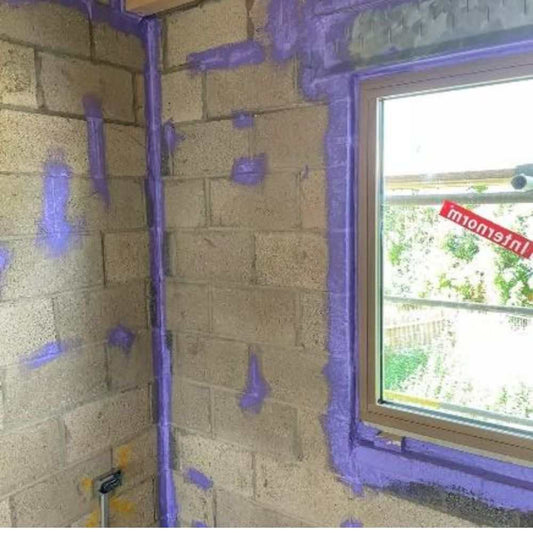
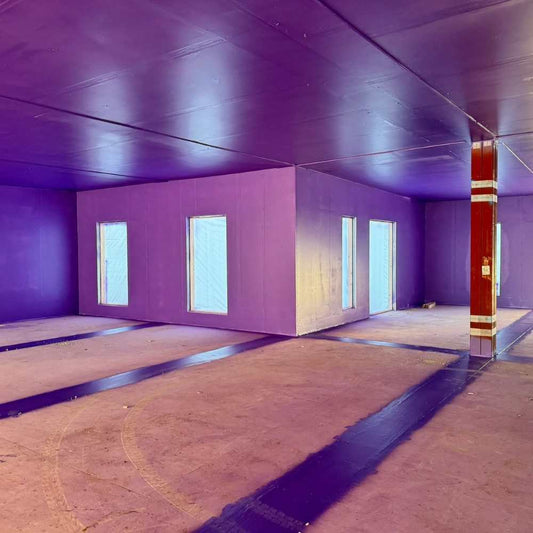
A liquid membrane removes the category. Passive Purple is applied wet, by spray or brush, across floors, walls and junctions, curing into a single continuous film with no laps or joints. It bonds to brick, block, concrete, timber and steel, follows complex details, and self-seals around service penetrations — precisely where sheet systems fail. For a gas barrier, continuity is everything, and a liquid coating delivers it by design rather than by workmanship. Detail joints and larger penetrations with IM Fleece Tape and airtight sealant to keep the envelope continuous through the awkward parts.
It is also the only realistic option on many retrofit jobs. Fitting a sheet gas barrier under an existing floor, around existing services and against existing walls is somewhere between miserable and impossible. A coating applied to the surfaces already there is not. See Radon Retrofit: The Ultimate Extra Line of Defence.

What independent test data sits behind the claim?
The key measure for a radon barrier is its radon diffusion coefficient (D) — how readily radon passes through the material. The lower the number, the better the barrier.
Passive Purple was tested to ISO/TS 11665-13 (method C) at the Czech Technical University in Prague, returning D = (3.3 ± 0.3) × 10⁻¹² m²/s, report 124044/2019. A benchmark commonly cited for radon-proof membranes sits around 10⁻¹¹ m²/s, so this result is roughly an order of magnitude below it. We present that as context rather than a formal pass or fail: the specifier should confirm the requirement for their particular project and design.
For methane, Passive Purple was tested for gas permeation to ISO 15105 at Mecadi GmbH in Germany, returning 62, 72 and 75 cm³(STP)·mm·m⁻²·day⁻¹·atm⁻¹ across three samples. Those are independent figures a gas protection consultant can work from, rather than a claim that a product "is a methane barrier".
Airtight White is the same formulation as Passive Purple, so the ground-gas performance comes with whichever finish suits the build-up. Waterproof Blue liquid DPM separately carries radon barrier certification, which is what makes it useful where the ground floor build-up has to serve as damp proof membrane and gas barrier at once.
Because the same coating is also the airtight and vapour control layer, the ground-gas specification stops being a separate layer with its own interfaces. Passive Purple is certified by the Passivhaus Institut in Class A (phA) at an air permeability of 0.02 (±0.002) m³/(h·m²) at 50 Pa to EN 12114, tested as a system including its connections — one fifth of the phA limit of ≤0.10. Ghent confirmed 0.019; in the US the air permeance is 0.02 L/s·m² at 75 Pa under ICC-ES ESR-4715. Emissions are classified M1. An ACH figure is a property of a finished building, never of a product: no membrane has an ACH.
The full write-up, with the reports referenced, is in Passive Purple as a Radon and Methane Barrier, with the wider picture in Radon Barriers Explained. We are members of the Radon Council — the announcement is here.
Which products go on a ground gas job?
Passive Purple (11.4 kg, spray or roller)
- Radon diffusion coefficient (3.3 ± 0.3) × 10⁻¹² m²/s, ISO/TS 11665-13
- Methane permeation 62, 72, 75 cm³(STP)·mm·m⁻²·day⁻¹·atm⁻¹, ISO 15105
- Passivhaus Class A (phA), 0.02 (±0.002) m³/(h·m²) at 50 Pa, EN 12114
- Emissions class M1
- Coverage 0.8–1.0 kg/m²
The field coat: gas barrier, airtight layer and vapour control layer in one continuous film.
Airtight White
The same formulation as Passive Purple, so the radon and methane performance comes with it. Choose on the basis of the finish the build-up needs rather than on performance.
Waterproof Blue liquid DPM
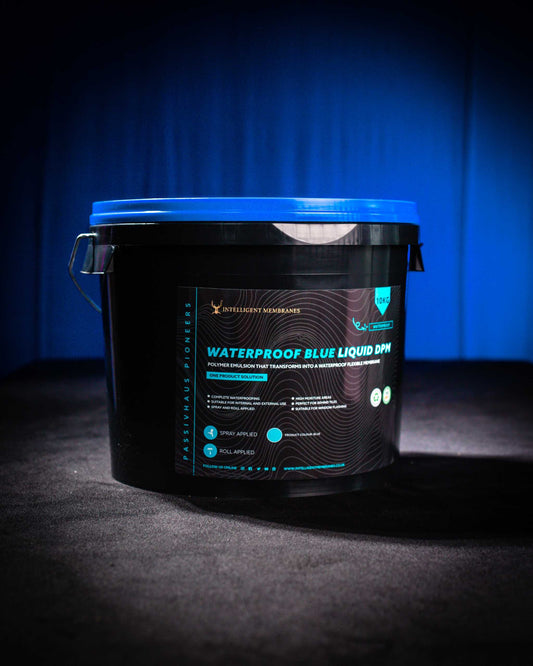
Carries radon barrier certification alongside its damp proofing role — the option where a block-and-beam floor, slab or kicker detail has to be both DPM and gas barrier. See our waterproofing page.
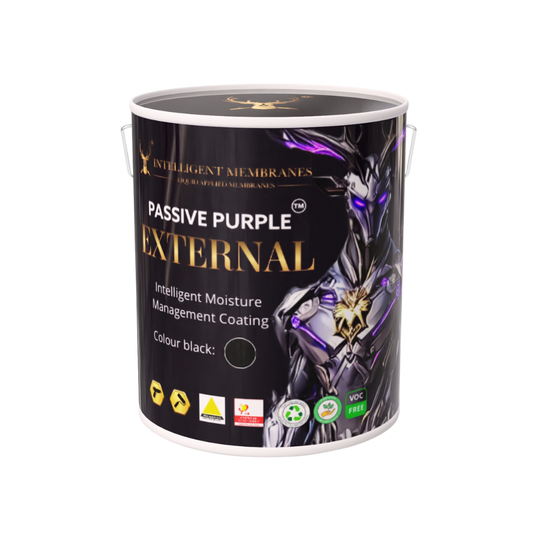
Passive Purple External
- EN 13501-1 Class B-s1,d0 (PAVUS PK1-01-20-065-E-1)
- sd 0.62 m, EN ISO 12572 (Kiwa BDA BAW-21-214-P-A-UK)
- Coverage 1.0–1.2 kg/m² on blockwork and brickwork
Where the barrier has to continue up an external below-ground or ground-level wall as part of the envelope.
Detailing
- IM Fleece Tape at material changes and frames
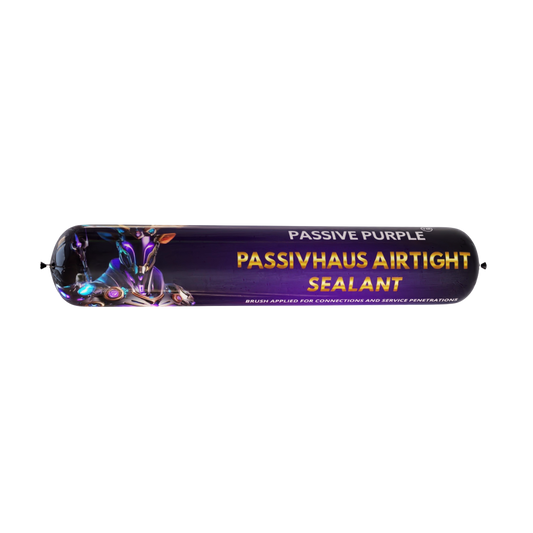
- IM Passivhaus Sealant for larger gaps
Service penetrations, floor perimeters and construction joints are where gas gets in. Detail them, then coat over them.
Primers
- Supergrip Primer — 0.2–0.3 kg/m²
- Lime Prime — 0.15–0.25 kg/m²
- IM Primer — 0.15–0.25 kg/m²
Ground floor substrates are dusty and absorbent. Adhesion to BS EN ISO 4624 is 1.02 N/mm² on concrete but only 0.04 N/mm² on wood fibre — prime where the figure is low.

How much material should we allow?
| Product | Substrate | Coverage |
|---|---|---|
| Passive Purple | OSB and plasterboard | 0.8–1.0 kg/m² (approx. 10–12 m² per tub) |
| Passive Purple External | Blockwork and brickwork | 1.0–1.2 kg/m² (approx. 8–10 m² per tub) |
| Supergrip Primer | Where adhesion needs improving | 0.2–0.3 kg/m² |
| Lime Prime / IM Primer | Lime backgrounds / general | 0.15–0.25 kg/m² |
Full figures are on the application and coverage rates page. Ground floor slabs and blockwork sit at the top of the range; allow for that in the take-off.
Has it been proved on real buildings?
The gas performance is evidenced by the laboratory reports above; the continuity of the installed membrane is evidenced by whole-building air tests, because a barrier that seals against air at those levels has no meaningful gaps in it. Our best result on a school is 0.078 ACH at Wester Hailes High School, Edinburgh — a whole-building pre-test after our works on McLaughlin & Harvey's £44m Passivhaus school, measured by EDP Building Sciences to ATTMA TSL4 in November 2025 against a 0.6 design target.
| Project | Building | Result |
|---|---|---|
| Wester Hailes High School | £44m Passivhaus school, Edinburgh | 0.078 ACH |
| Everton Heath Primary School | School building | 0.3 ACH |
| Bedford Academy | Teaching extension, mixed construction | 0.43 ACH |
| Reuben College, Oxford | Basement, Airtight White | Award-winning basement airtightness |
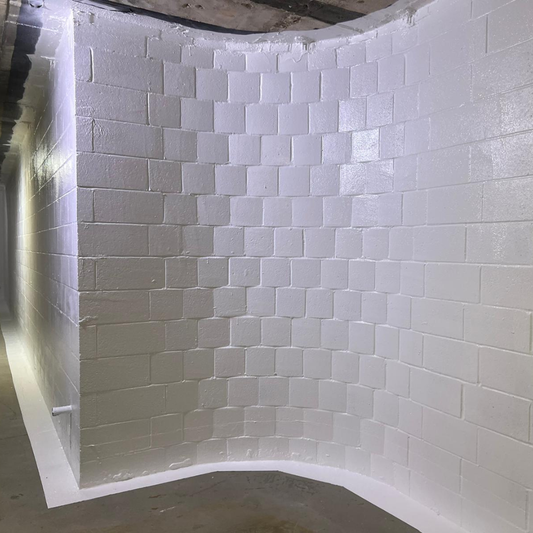
Reuben College is the most directly relevant: a below-ground environment sealed with Airtight White, the same formulation carrying the radon and methane test data. On projects we install, we guarantee 0.6 ACH or lower — for scale, the limiting air permeability for a new dwelling under Approved Document L (2021 edition incorporating the 2023 amendments) is 8.0 m³/(h·m²) at 50 Pa, with the notional dwelling at 5.0.

Can we see it on site before we specify it?
Verification is central to every ground gas guidance document, and the same instinct applies before specification. The 360° tours let a client-side team walk completed applications and look at floor perimeters, service penetrations and junctions as they were left rather than as drawn; the video channel shows the spray and brush-detailing sequence in real site conditions.
360° site tours Application videos Technical details and drawings
Frequently asked questions
What is the radon diffusion coefficient, and what is yours?
It measures how readily radon passes through a material — the lower the better. Passive Purple was tested to ISO/TS 11665-13 (method C) at the Czech Technical University in Prague at D = (3.3 ± 0.3) × 10⁻¹² m²/s, report 124044/2019. A benchmark commonly cited for radon-proof membranes sits around 10⁻¹¹ m²/s; we offer that as context, not a formal pass or fail.
Does it stop methane and carbon dioxide as well?
Passive Purple was tested for gas permeation to ISO 15105 at Mecadi GmbH in Germany, returning 62, 72 and 75 cm³(STP)·mm·m⁻²·day⁻¹·atm⁻¹ for methane across three samples. Those figures are for your gas protection consultant to assess against the requirement established by the site investigation.
Can it be used as a barrier and the airtight layer at once?
Yes — that is the point of it. One continuous coating serves as gas barrier, airtight layer and vapour control layer, which removes the interfaces between three separate products. Passive Purple is Passivhaus Class A (phA) at 0.02 (±0.002) m³/(h·m²) at 50 Pa to EN 12114, tested as a system including connections.
Does it comply with BS 8485 or BRE 211?
Design compliance for a specific building is determined by the project's gas protection consultant from the site investigation, not by a product datasheet. What we publish is the independent diffusion and permeation data above, with the laboratories and report numbers, so it can be assessed against whatever the design requires. Talk to us and we will supply the reports.
Can it be applied in an existing building?
Yes, and that is often the deciding factor. Fitting a sheet gas barrier around existing services and against existing walls is extremely difficult; a coating applied to the surfaces already there is not. Existing substrates are dusty and absorbent, so priming is normal rather than exceptional.
Do we still need ventilation and a sump?
Where the radon map indicates full protection, that means the barrier plus a ventilated sump or void — the membrane is one part of the strategy, not a substitute for it. Managing radon is about controlling its movement and preventing build-up indoors, through design, materials, ventilation and, where necessary, testing.
Two ways to work with us on a ground gas project
Supply. Buy the membrane, primers and detailing materials and apply them with your own operatives or groundworks contractor. We will supply the ISO/TS 11665-13 and ISO 15105 reports for your gas consultant.
Supply and install. We apply the system ourselves, and on projects we install we guarantee 0.6 ACH or lower. Send the site investigation, the gas risk assessment and the ground floor build-up and we will come back with an approach and a price.
Supply — view the range Supply and install — talk to usShop Radon & Ground Gas Barriers
-
Oferta
-
Pintura Passive Purple - Control de vapor, hermética y a prueba de humo (11,4 kg) - Aplicación con pulverizador o rodillo
Short spec • 11.4 kg
Licenciatura en Administración de EmpresasOferta -
Sellador hermético Passivhaus - 600 ml
Short spec • 840 g
Licenciatura en Administración de EmpresasOferta