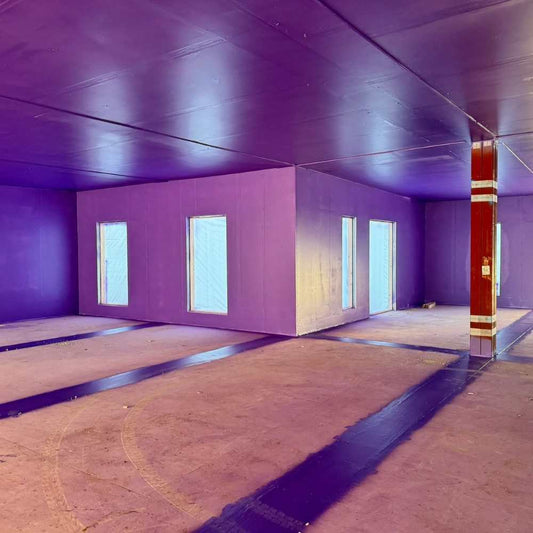
Internal
Why does the airtight line belong on the inside face?
The internal face of the walls and roof is where a building's airtight line is normally drawn, and it is where most air tests are decided. It is the warm side, so it is also the correct position for vapour control. It is reachable at first fix, before services, insulation and linings close everything off. And it is continuous in a way the outside face often is not, because it is not interrupted by cavity trays, wall ties and cladding rails.
What it is not, on most sites, is a single clean plane. An internal envelope is blockwork, then a change to timber at a floor zone, then OSB or sheathing board in a panelised bay, then a steel column where a beam lands, then plasterboard around a riser. Between those materials sit the junctions that leak: wall-to-floor perimeters, joist ends built into masonry, ceiling perimeters, window and door reveals, service penetrations, and the head of the wall where it meets the roof structure.
Sheet and tape systems address each of those individually. Every board joint takes a strip of tape, every reveal a cut piece, every socket and pipe a collar, every lap a bonded seam whose performance depends on the substrate being clean, dry and dust free at the moment the roller went over it. Across a house that is hundreds of separate operations; across an apartment block, thousands. None of them is inspectable once the lining is on.
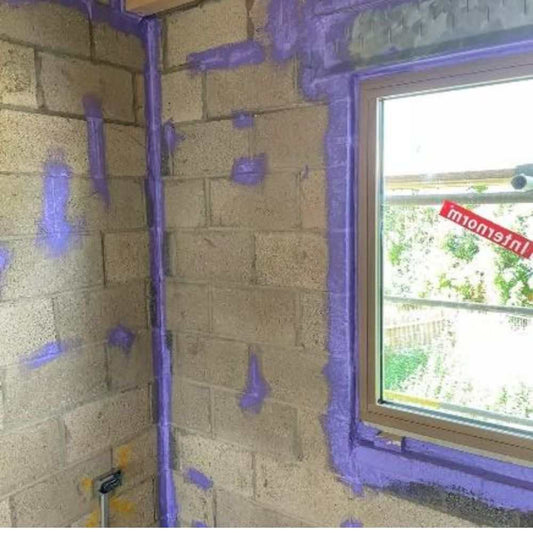
A liquid membrane inverts the problem. Passive Purple is sprayed or rollered onto the structure and cures into one continuous film. Board joints are not sealed one at a time — they are simply part of the surface being coated. Material changes, reveals, fixings and penetrations are wetted out in the same pass. What still needs deliberate attention is detailed with the brush grade of the same chemistry, so the detail and the field are one material rather than two systems relying on an adhesive between them.

What does Approved Document L actually say about the internal lining?
Approved Document L, 2021 edition incorporating the 2023 amendments, sets a limiting air permeability of 8.0 m³/(h·m²) at 50 Pa for new dwellings, with the notional dwelling at 5.0. Both figures are widely quoted. The change that decides whether a scheme passes is quieter: every new dwelling is now pressure tested, which removes the averaging that once let a partly reliable air barrier carry a site.
The document is also specific about the layer. Paragraph 4.21(e) states: "Internal plasterboard linings are not appropriate for use as an air barrier solution." The same paragraph names liquid membranes, alongside plaster and parge coat, among the internal applications that should be used to reduce air permeability where dense aggregate blocks have been used.
Two qualifications matter. Approved Document L is statutory guidance rather than statute — you may depart from it and demonstrate compliance another way, but you should not depart from it by accident. And that sentence sits in Volume 1 for new dwellings with cavity walls in England; Wales, Scotland and Northern Ireland run their own wording, and Volume 2 covers non-domestic buildings separately. Our longer treatment is in Part L and the air barrier line and Airtightness and Part L: UK air permeability targets explained.
Note also that Part L's air permeability and the Passivhaus threshold are different measures. Part L works in m³/(h·m²) at 50 Pa — flow per square metre of envelope area. Passivhaus works in air changes per hour, 0.6 ACH at 50 Pa, referenced to internal volume. They are not interchangeable and should not be converted casually in a specification.
Why does the void behind dot-and-dab leak?
Because the leak is not at the visible joint. Behind a dab-fixed lining runs an interconnected void — past sockets, round reveals, into the ceiling zone, over the joist ends — and air moves through it freely whatever is done to the room-side face. That is the practical reason a lining is a poor place to draw the line: sealing the perimeter of a plasterboard skin seals around the void rather than closing it.
Putting the membrane on the structure itself — blockwork, concrete, OSB, sheathing board — takes the void out of the strategy entirely. The film goes on behind the lining, at first fix, while every junction is still reachable, and the lining then does the job it is good at, which is finish. Plaster and dot-and-dab bond over the cured membrane with Supergrip Primer; see Getting plaster and dot-and-dab to stick to airtight membranes.

Will an airtight coating trap moisture?
This is the objection we hear most, and it rests on treating air movement and vapour diffusion as the same thing. They are not. Air moves in bulk through gaps and joints, driven by wind and pressure, and it carries far more moisture into a construction than diffusion ever does. Vapour diffuses slowly through materials, driven by humidity differences. Airtightness stops the first; vapour control manages the second.
Passive Purple does both in one film. It is the airtight layer and the vapour control layer, which means the sealed surface is also the layer governing how much moisture can enter the construction — and it stays airtight at all times while remaining vapour open when the fabric needs to dry back into the room. That matters most on retrofit, where an old wall holds historic moisture and a permanently vapour-closed polythene sheet removes the inward drying path just when it is needed. The full explanation is in Will airtight paint trap moisture? and Do I need a vapour barrier? A UK guide.
Whether a specific build-up carries an interstitial condensation risk is assessed, not assumed. We do not carry out condensation risk analysis ourselves — it is normally produced by the insulation manufacturer, and several provide it free with their system. The free services are listed on our condensation risk analysis page.
The other half of the answer is ventilation. Sealing the fabric does not make a home stuffy; it moves fresh air from accidental leakage to designed supply. Once the envelope is tight, the ventilation strategy has to be deliberate and has to keep working while people live in the building.
Which junctions decide the result?
In our experience the field areas are rarely the problem. The result is set at the interfaces, and four of them come up on almost every project.
Joist ends
Timber built into masonry leaves a gap around every joist. Individually small, collectively decisive, and unreachable once the floor and ceiling close up. Seal them at the right moment — see sealing joist ends.
Service penetrations
Pipes, cables, ducts and flues each break the film. They are sealed against the structural layer at first fix, while access still exists, rather than against a lining afterwards.
Reveals and frames
Four reveals, a cill, a head and eight cut corners per opening. The membrane runs onto the frame interface, with IM Fleece Tape where a plasterable, vapour-open tape is the right answer.
Wall head and floor perimeter
Where the wall meets the roof structure and where it meets the slab or floor deck. Detailed in brush grade, then tied into the sprayed field coat in the same material.
The sequence that works: prepare and prime the substrate, apply the first coat, detail penetrations and junctions while access is easy, then apply the second coat to build the specified film thickness. Passive Purple is a two-coat system, and a thin membrane is an incomplete membrane — skipping the second coat is the most common cause of a disappointing test with any liquid membrane. Before the test itself, work through the pre-test checklist.

Which products go on the internal line?
Passive Purple (11.4 kg, spray or roller)
- Passivhaus Institut certified Class A (phA)
- Air permeability 0.02 (±0.002) m³/(h·m²) at 50 Pa to EN 12114, tested as a system including its connections
- Air permeance 0.02 L/s·m² at 75 Pa, ICC-ES ESR-4715
- Elongation 219%, tensile 17 N/50mm (BBRI, EN 12311-1)
- Emissions class M1, valid to 01.09.2027 (Rakennustieto)
- Coverage 0.8–1.0 kg/m² on OSB and plasterboard
The field coat for the internal airtight and vapour control line, applied to the structure behind plaster or lining.
Passive Purple Brush (6.9 kg)
- Same Passive Purple chemistry as the sprayed field coat
- Detail grade for joist ends, perimeters, reveals, beam ends and penetrations
Detail and field become one material rather than two systems bonded together at exactly the points that leak.
Airtight White
The same approach where the airtight layer is left on show or painted over, rather than hidden behind a lining. Read an airtight vapour control layer you can leave on show.
IM Fleece Tape and IM Passivhaus Sealant
Plasterable, vapour-open tape for frames and board joints; flexible sealant for larger gaps and movement joints at interfaces.
Primers
- Supergrip Primer — 0.2–0.3 kg/m²
- Lime Prime — 0.15–0.25 kg/m², lime and porous backgrounds
- IM Primer — 0.15–0.25 kg/m², dense and smooth backgrounds
Which primer on which substrate is set out on our primers page.
Adhesion, BS EN ISO 4624
- Concrete 1.02 N/mm²
- Plywood 0.75 N/mm²
- OSB 0.42 N/mm²
- Gypsum sheathing 0.24 N/mm²
- Wood fibre 0.04 N/mm²
Published in full, low figures included. Those are the substrates to discuss a primer for before the specification is fixed — see the adhesion testing.
How much material should we allow?
| Product | Substrate | Coverage |
|---|---|---|
| Passive Purple | OSB and plasterboard | 0.8–1.0 kg/m² |
| Passive Purple External | Blockwork and brickwork | 1.0–1.2 kg/m² |
| Supergrip Primer | Cured membrane before plaster; smooth ICF and concrete | 0.2–0.3 kg/m² |
| Lime Prime | Lime, porous and dusty backgrounds | 0.15–0.25 kg/m² |
| IM Primer | Dense and smooth backgrounds | 0.15–0.25 kg/m² |
Figures are per coat and vary with substrate porosity, application method and the film thickness specified for the project. Full figures for every product are on the application and coverage rates page, and the practicalities of coats, curing and finishing are covered in the application FAQ.
Has it been proved?
Our best result on a school is 0.078 ACH at Wester Hailes High School, Edinburgh — a whole-building pre-test after our works on McLaughlin & Harvey's £44m Passivhaus school, measured by EDP Building Sciences to ATTMA TSL4 in November 2025, against a 0.6 design target.
Everton Heath Primary School returned 0.3 ACH. At Bedford Academy, a teaching extension where the airtight line crossed masonry, timber, OSB, steel interfaces and plasterboard, beam ends and penetrations were detailed in brush grade with the field areas sprayed. At Reuben College, Oxford, Airtight White carried the line in an award-winning basement, and Oxford Brookes University is another completed application on the internal face.
The certification behind those results is worth reading in its own right: Passive Purple's Passivhaus air permeability figure of 0.02 (±0.002) m³/(h·m²) at 50 Pa is one fifth of the phA limit of ≤0.10, and it was measured as a system including its connections rather than as a sheet of material. Ghent University independently confirmed 0.019.
Wester Hailes — 0.078 ACH Bedford Academy Reuben College, Oxford Oxford Brookes University
Can we see it before specifying it?
Yes, and we would rather you did. The 360° tours let a design or client-side team walk completed applications and look at joist ends, reveals and penetrations as they were actually left, not as they were drawn. The video channel shows the detailing and spray sequence on site, which is usually what settles the question of how a liquid membrane handles a difficult junction.
360° site tours Application videos Technical details and drawings

Frequently asked questions
What airtightness result do you guarantee?
On projects we supply and install, we guarantee 0.6 ACH or lower. Our best result on a school is 0.078 ACH at Wester Hailes High School, measured by EDP Building Sciences to ATTMA TSL4 in November 2025 against a 0.6 target.
Can the plasterboard lining be the air barrier?
Approved Document L, paragraph 4.21(e), states that internal plasterboard linings are not appropriate for use as an air barrier solution, and names liquid membranes among the internal applications that should be used instead where dense aggregate blocks have been used.
Is 0.6 ACH the same as the Part L figure?
No. Part L works in air permeability, m³/(h·m²) at 50 Pa, with a limiting value of 8.0 for new dwellings and 5.0 for the notional dwelling. Passivhaus works in air changes per hour, 0.6 ACH at 50 Pa. They are different measures and are not interchangeable.
Will sealing the inside face cause condensation?
Air leakage carries far more moisture into a construction than diffusion does, so an airtight layer is most of the moisture solution rather than the problem. Passive Purple is airtight at all times and vapour open when the fabric needs to dry. Whether a specific build-up carries a risk is assessed by condensation risk analysis, which the insulation manufacturers provide — several free.
Can we plaster or dot-and-dab straight over it?
Yes, once the membrane has fully cured, with Supergrip Primer applied first to give the plaster or adhesive a mechanical key on the smooth membrane surface. Supergrip covers 0.2–0.3 kg/m².
How well does it bond to our substrates?
Pull-off adhesion to BS EN ISO 4624 is 1.02 N/mm² on concrete, 0.75 on plywood, 0.42 on OSB, 0.24 on gypsum sheathing and 0.04 on wood fibre. We publish the low figures as well as the high ones — those are the substrates where a primer should be discussed before the specification is fixed.
Two ways to work with us on the internal line
Supply. Buy the membrane, primers, tapes and sealants and apply them with your own operatives or your subcontractor.
Supply and install. We apply the system ourselves, and on projects we install we guarantee 0.6 ACH or lower. Send the drawings, the substrates and the target, and we will come back with an approach and a price.
Supply — view the range Supply and install — talk to usShop Airtight Paint & Membranes
-

 PromotionPromotion
 -

 PromotionPromotion
 -

Passive Purple External Airtight Fire Rated Façade Waterproofing Membrane (10kg) - Spray / Roller
Short spec • 10.0 kg
KIWA PassivhausPromotion -

 PromotionPromotion
 -
 Promotion
Passive Purple X (5kg) Brush Applied
Short spec • 5.0 kg
Promotion