Weatherproofing
Why does a facade leak air and water at the same time?
Ask a specifier where a wall leaks and the honest answer is never "the middle of the panel". It leaks at the junctions. The board-to-board joints on 400 or 600 mm stud centres. The head and base tracks at every floor. The slab edge with its band of fire stopping. Every window and door opening, with four reveals, a cill, a head and eight cut corners. Every helping-hand bracket, rainwater outlet, extract terminal and service entry — and on a rainscreen elevation the bracket count alone runs to several per square metre.
The same junctions that leak air leak water. Wind-driven rain does not need a hole; it needs a gap and a pressure difference, and both are present at exactly the details a tape-and-sheet system relies on to be perfect. A breather membrane addresses each one individually: a strip of tape per board joint, a cut piece and a corner detail per reveal, a collar per bracket, a bonded lap wherever two sheets meet. Across a mid-rise elevation that is thousands of separate operations, each an opportunity for a leak, and none of them inspectable once the insulation and rails go on.
A liquid membrane inverts the problem. The material is sprayed or rollered onto the substrate and cures into one continuous film. Board joints are not sealed one at a time — they are simply part of the surface being coated. Reveals, corners, bracket penetrations and the fixings themselves are wetted out in the same pass. There are no laps, because there are no sheets. What still needs deliberate attention — movement joints, the slab edge, larger penetrations — is detailed with the brush grade of the same material, so the detail and the field are one product rather than two systems relying on an adhesive between them.

What does "weatherproof" actually have to mean on a modern facade?
Weatherproof on its own is not a specification. Four separate performances have to be evidenced, and a product that is excellent at one while being silent on the others is not a facade membrane.
It has to shed liquid water. Passive Purple External is classified water permeability Class W3 to BS EN 1062-3, with capillary water absorption of 0.004 ml/cm². That is the number that matters in the window between the membrane going on and the cladding going up, when the coated substrate is the only thing standing between the weather and the building.
It has to let the wall dry. This is the performance that catches out film-forming coatings. A membrane that seals a wall against rain and also against vapour traps moisture inside the construction, and on solid masonry or a timber frame that is a decay risk rather than a comfort issue. Passive Purple External is sd 0.62 m (3.1 MNs/g) to EN ISO 12572 under Kiwa BDA Agrément BAW-21-214-P-A-UK — genuinely vapour-open, so the wall dries outwards behind insulation or cladding while the film sheds rain from the outside.
That balance is not a fixed target, and our note on why breather membranes now need to be more vapour-closed sets out why the industry has moved away from assuming that ultra-vapour-open is always safest. Whether a given sd value is right for a given wall depends on the build-up, the insulation position and the exposure zone — which is a hygrothermal question, assessed rather than assumed. We do not carry out condensation risk analysis ourselves. On most projects it is produced by the insulation manufacturer, and several of them provide it free with their system; we have listed those on our condensation risk analysis page.
It has to move. Substrate, frame and insulation move at different rates, and a coating that cannot follow them cracks. Passive Purple External is crack-bridging Class A3 at 23 °C and Class A4 at −10 °C to BS EN 1062-7, so the film accommodates movement in cold weather as well as warm.
It has to satisfy the fire strategy. This is where most liquid air barriers are ruled out of an external build-up before their weather performance is ever discussed. Passive Purple External is classified Class B-s1,d0 in accordance with EN 13501-1, under PAVUS classification report PK1-01-20-065-E-1 — reaction to fire B, s1 for smoke production, d0 for flaming droplets. That is what allows the weather and air line to sit on the outer face of the sheathing within a rainscreen build-up rather than being pushed to the warm side. Quote it in full, and note that EN 13501-1 and the ASTM scheme used in North America are separate systems that must never be merged: use whichever applies to the project.

Read the full breakdown in Passive Purple External: Fire Class B, Watertight and Breathable, and the argument for collapsing four layers into one in Airtight, Weatherproof, Fire-Rated Facades.
Can it be applied to an occupied building?
On re-cladding and overcladding this is usually the reason it gets chosen. The weather and airtight layer goes onto the outer face as part of the cladding works — same scaffold, same access, same trade sequence. Nothing has to happen inside the flats.
The commercial consequence is direct: no decant, no appointments with residents, no internal works package, no making good, no restricted working hours in occupied dwellings. On social housing remediation, student accommodation, hotels and hospitals, the cost and programme risk of getting inside every unit is frequently larger than the cost of the membrane itself. Working externally also keeps the line continuous past what breaks an internal one — compartment floors, party walls, risers, and finishes the fire strategy requires to stay intact.
Re-cladding is also, practically, the only moment the whole envelope is exposed at once. Our guides cover both scales of the work: spray-applied external airtightness for retrofit and re-cladding for the open elevations, and vapour-open external airtightness for retrofit for the brush-grade detailing that goes with it.

What goes on exposed brickwork that has to stay looking like brickwork?
Not every wall gets a cladding build-up over it. Older and exposed masonry soaks up driving rain faster than it can dry, and the result is penetrating damp: patches anywhere on the elevation after wind-driven rain, internal staining, blistering paint, cold spots and, over time, spalling brick and mortar as trapped water freezes and thaws. A wet wall is also a poorly performing wall — saturated masonry loses far more heat than dry masonry.
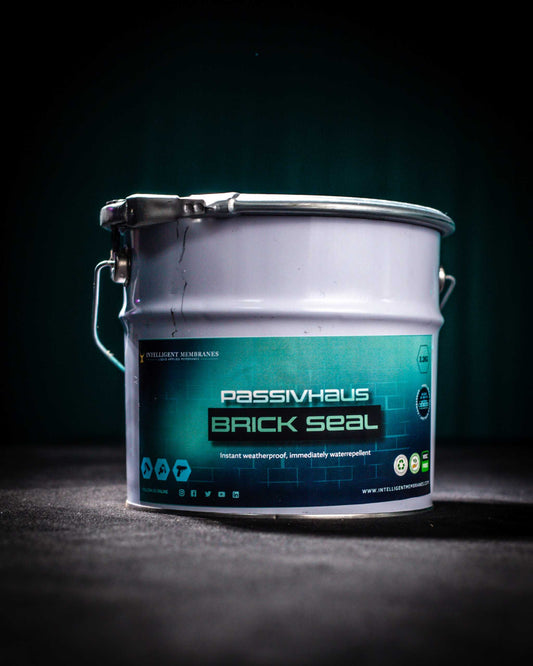
The wrong fix is a film-forming, non-breathable sealer that traps the moisture inside. The right fix repels liquid rain from the outside while staying vapour-open, so anything already in the masonry can still dry out. Passivhaus Brickseal is a cream-based water repellent that penetrates into the masonry and cures within the wall rather than forming a skin on it. It dries clear and matt, which is what makes it usable on heritage and visible brickwork where the appearance is the point. Repoint failed mortar first, then brush, roller or spray it onto clean, dry, sound masonry. The full method is in How to Stop Penetrating Damp in Brickwork.

Which products go on the outside of the building?
Passive Purple External (10 kg, spray or roller)
- EN 13501-1 Class B-s1,d0 (PAVUS PK1-01-20-065-E-1)
- sd 0.62 m / 3.1 MNs/g, EN ISO 12572
- Water permeability Class W3, BS EN 1062-3
- Water absorption 0.004 ml/cm²
- Crack bridging A3 at 23 °C, A4 at −10 °C, BS EN 1062-7
- Passivhaus class phB, 0.16 m³/(hm²), component ID 2380as00
The field coat for facades, rainscreen build-ups, re-cladding and high-rise remediation. Coverage 1.0–1.2 kg/m² on blockwork and brickwork.
Passive Purple External Brush (5 kg)
The detail grade of the same material, for reveals, junctions, movement joints, slab edges and penetrations. Detail and field become one membrane rather than two systems bonded together at exactly the points that matter most.
Passivhaus Brickseal
Breathable cream water repellent for exposed masonry. Penetrates and cures within the wall, dries clear, keeps the brickwork vapour-open — weather protection where the brick has to stay on show.
IM Fleece Tape
Keeps the line continuous where materials meet and where a coating alone is not the right answer — window and door frames, dissimilar substrates, and interfaces that have to tolerate movement.
Primers
- Supergrip Primer — 0.2–0.3 kg/m²
- Lime Prime — 0.15–0.25 kg/m², lime-based backgrounds
- IM Primer — 0.15–0.25 kg/m²
External substrates are absorbent, dusty and mixed, particularly on existing buildings. Priming is normal rather than exceptional.
Adhesion, BS EN ISO 4624
- Concrete 1.02 N/mm²
- Plywood 0.75 N/mm²
- OSB 0.42 N/mm²
- Gypsum sheathing 0.24 N/mm²
- Wood fibre 0.04 N/mm²
Published in full, including the low figures — those are the substrates to discuss a primer for before the specification is fixed.
How much material should we allow?
| Product | Substrate | Coverage |
|---|---|---|
| Passive Purple External | Blockwork and brickwork | 1.0–1.2 kg/m² (approx. 8–10 m² per tub) |
| Passive Purple External | OSB and plasterboard | 0.8–1.0 kg/m² (approx. 10–12 m² per tub) |
| Supergrip Primer | Where adhesion needs improving | 0.2–0.3 kg/m² |
| Lime Prime | Lime-based backgrounds | 0.15–0.25 kg/m² |
| IM Primer | General priming | 0.15–0.25 kg/m² |
Full figures for every product are on the application and coverage rates page. Take-offs should allow for substrate absorbency: rough or porous blockwork sits at the top of the range, smooth board at the bottom.

Has it been proved on real buildings?
Only measured results are quoted here. Our best result on a school is 0.078 ACH at Wester Hailes High School, Edinburgh — a whole-building pre-test after our works on McLaughlin & Harvey's £44m Passivhaus school, measured by EDP Building Sciences to ATTMA TSL4 in November 2025, against a 0.6 design target.
| Project | Building | Result |
|---|---|---|
| Wester Hailes High School | £44m Passivhaus school, Edinburgh | 0.078 ACH |
| London retrofit | Existing dwelling | 0.3 ACH |
| Everton Heath Primary School | School building | 0.3 ACH |
| Bedford Academy | Teaching extension, mixed construction | 0.43 ACH |
| Ferndale Rise | 1930s semi, stripped back to brick | 0.54 ACH |
| Dudley College | 1950s masonry, £7.5m deep retrofit | 0.91 ACH |
For scale: the limiting air permeability for a new dwelling under Approved Document L (2021 edition incorporating the 2023 amendments) is 8.0 m³/(h·m²) at 50 Pa, with the notional dwelling at 5.0. On projects we install, we guarantee 0.6 ACH or lower. See also airtight membranes on brickwork for the membrane applied directly over existing masonry.
Can we see it on site before we specify it?
Inspect a completed application before committing a project to it. The 360° tours let a design or client-side team walk coated elevations and look at reveals, junctions and bracket penetrations as they were actually left, rather than as they appear on a detail drawing. The video channel shows the spray and brush-detailing sequence in real conditions.
360° site tours Application videos Technical details and drawings
Frequently asked questions
What fire classification does the external membrane carry?
Class B-s1,d0 in accordance with EN 13501-1, under PAVUS classification report PK1-01-20-065-E-1. EN 13501-1 and the North American ASTM scheme are separate classification systems and should never be combined or presented as equivalent — quote whichever applies to your project.
If it keeps rain out, does the wall still dry?
Yes. Passive Purple External is sd 0.62 m (3.1 MNs/g) to EN ISO 12572 under Kiwa BDA Agrément BAW-21-214-P-A-UK, so it is vapour-open and the wall dries outwards, while resisting driving rain at water permeability Class W3 to BS EN 1062-3 with water absorption of 0.004 ml/cm².
Do you produce the condensation risk analysis?
No. We do not carry out condensation risk analysis. On most projects it is produced by the insulation manufacturer, and several of them provide it free with their system — we have listed those on our condensation risk analysis page.
Will it bond to our substrate?
Pull-off adhesion to BS EN ISO 4624 is 1.02 N/mm² on concrete, 0.75 N/mm² on plywood, 0.42 N/mm² on OSB and 0.24 N/mm² on gypsum sheathing. Wood fibre is far lower at 0.04 N/mm², so discuss a primer wherever the membrane runs onto absorbent or friable faces.
Can it go on without entering occupied homes?
Yes, where the work is external. On re-cladding, overcladding and re-render programmes the membrane is applied to the outer face from the cladding scaffold — no decant, no appointments inside flats, no internal works package.
How much material should we allow?
Passive Purple External covers 1.0–1.2 kg/m² on blockwork and brickwork and 0.8–1.0 kg/m² on OSB and plasterboard. Supergrip Primer covers 0.2–0.3 kg/m²; Lime Prime and IM Primer cover 0.15–0.25 kg/m².
Two ways to work with us on a facade
Supply. Buy the membrane, primers and detailing materials and apply them with your own operatives or your cladding subcontractor.
Supply and install. We apply the system ourselves, and on projects we install we guarantee 0.6 ACH or lower. Send the elevations, the substrate and the fire strategy and we will come back with an approach and a price.
Supply — view the range Supply and install — talk to usShop Weatherproof Membranes
-

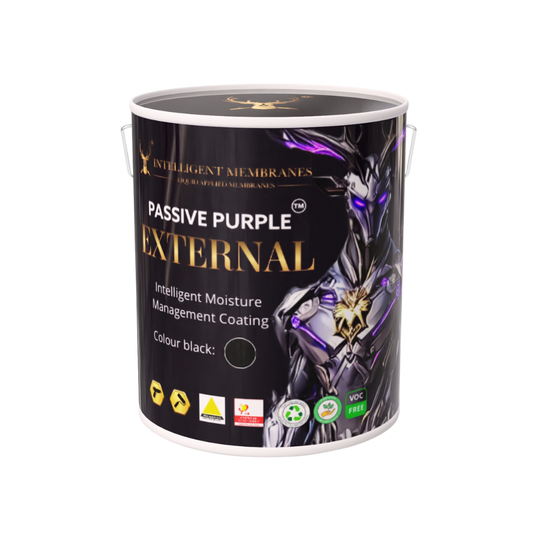
Passive Purple External Airtight Fire Rated Façade Waterproofing Membrane (10kg) - Spray / Roller
Short spec • 10.0 kg
KIWA PassivhausPromotion -

 PromotionPromotion
 -
 Promotion
Passive Purple X (5kg) Brush Applied
Short spec • 5.0 kg
Promotion -
 Promotion
Passive Purple External Brush Pack
Short spec • 5.0 kg
Promotion