Waterproofing
Why does waterproofing fail at the details?
Every sheet system is a collection of pieces held together by something else. A plastic DPM under a slab is a series of overlaps, taped and dressed up the upstands, with the tape doing the waterproofing at every joint. A tanking tray relies on a bonded seam at the wall-to-floor junction. A single-ply roof relies on welded laps and a collar around each outlet. The material between the joints is rarely what leaks. The joints are.
The pattern repeats because sheets are flat and buildings are not. A kicker joint, a pile cap, a ground beam, a service penetration, an internal corner in a wet room, a balcony threshold, a rainwater outlet — these are the shapes a flat sheet has to be cut, folded, lapped or collared to fit. Every one is a manual detail whose success depends on a specific person on a specific day, and almost none is inspectable once the screed, the tiles or the paving goes on.
A liquid-applied membrane removes the joints rather than trying to make them perfect. Applied wet — by brush, roller, spray or pour — it cures into a single monolithic layer bonded directly to the substrate, moulding itself around penetrations and awkward junctions with no seams to fail, and it cannot lift, tear or be punctured by following trades. Genuinely high-risk details are reinforced with tape, mesh or sealant and then coated, so the reinforcement sits inside the membrane rather than being the membrane.

Damp proofing or waterproofing — which does this detail need?
The two terms are used interchangeably on site and they should not be. The difference is what kind of water each is designed to stop.
Damp proofing resists moisture moving through the structure from the ground — capillary rise, ground moisture, vapour. It is the right answer where the internal floor level is above external ground level and there is no below-ground habitable space, so no significant water pressure acts on the construction. Approved Document C requires floors and walls next to the ground to resist moisture passing to the inside; a horizontal damp-proof course should sit at least 150 mm above external ground level, and ground floors need a damp-proof membrane.
Waterproofing resists water under pressure. Below ground, groundwater exerts constant hydrostatic pressure, and a system that merely resists capillary moisture will not hold it back. Where a below-ground room is habitable, the design follows BS 8102:2022, the code of practice for protection of below-ground structures against water from the ground — typically Grade 3, a dry environment.
Getting the diagnosis right matters as much as getting the product right. Rising damp shows as a tide mark up to around a metre above floor level, with salts on the plaster and crumbling skirtings. Penetrating damp shows as patches anywhere on the wall after wind-driven rain. Condensation is surface moisture and has a different cure entirely. Our guides work through all three: Damp Proofing vs Waterproofing and How to Stop Rising Damp with a Liquid DPM.
What goes under a floor and against a foundation?
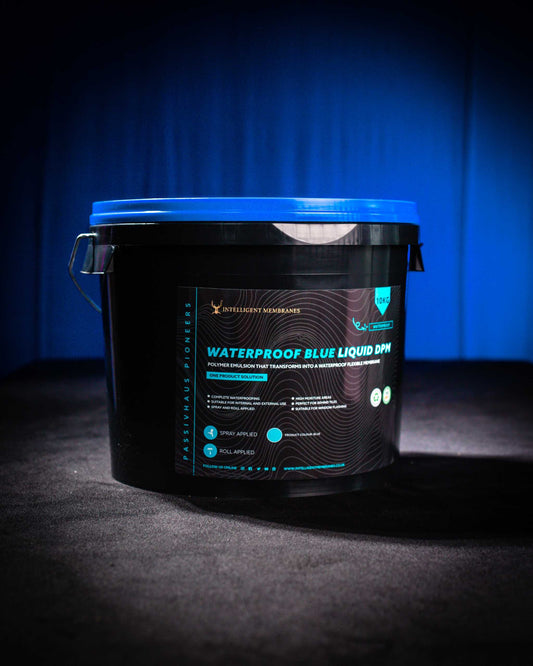
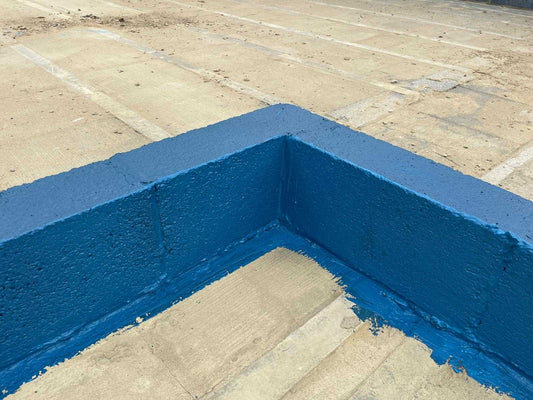
If you have worked on a block-and-beam floor or a kicker block detail, you know the usual approach: loose-laid plastic DPM sheet, taped and dressed up the upstands, hoping every lap holds through the follow-on trades. Waterproof Blue does the job differently — a polymer-modified, water-based, VOC-free liquid membrane applied by roller or brush in two crosswise coats, curing into one seamless, jointless barrier.
It goes anywhere a plastic DPM or DPC would traditionally be specified: block-and-beam floors before screed, kicker block upstands, foundation walls, basement floors and slabs, and behind coping stones. Use the 5 kg brush grade to seal reveals, upstands and junctions accurately. Because it forms a continuous unbroken membrane, it also carries radon barrier certification, which matters where the ground floor build-up has to double as a damp proof membrane and a gas barrier — see our underground gases page.

Where the structure is genuinely below ground and under pressure, the specification steps up to The GOAT, a solvent-free reactive polymer engineered for those conditions. It applies to damp surfaces at 0 °C, where standard coatings need a dry substrate and 5 °C or above — a real programme advantage in UK groundworks. It handles positive and negative water pressure, and is fully bonded and flexible, bridging shrinkage cracks and moving with the structure rather than debonding.
Typical applications are the external faces of foundation walls before backfilling, kicker joints, basement walls and roofs, pile caps and ground beams, and service penetrations. The 18 kg roller grade covers large flat and gently sloping areas quickly; the 7.5 kg thicker grade is mixed to a higher viscosity so it grips vertical surfaces without slumping, and can also be poured. Reinforcement is embedded at junctions and crack-risk areas before the second coat. Full method in How to Waterproof Foundations with The GOAT and Waterproofing Basements and Foundations.

What has to go behind the tiles in a wet room?
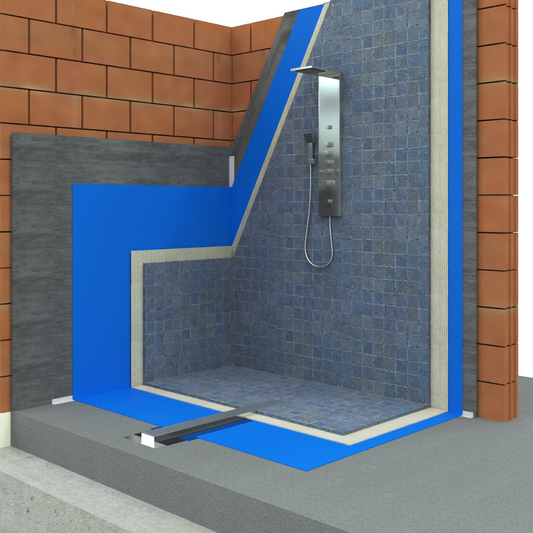
Under the NHBC Standards 2023 updates introduced in July 2023, all bath and shower enclosures, wet rooms and bathroom pods must incorporate an impermeable liquid-applied waterproofing membrane behind tiled finishes. The revision to Clause 9.2.5, "Ceramic Wall Tiling", followed a rise in insurance claims relating to failures around baths and shower enclosures. It makes clear that gypsum plasters must not be used in areas subject to repeated or persistent wetting, and that wet areas require backing surfaces protected with a suitable tanking system. The requirements are mandatory for every NHBC-registered home where foundations were begun on or after 1 January 2024, and at 9.2/06, Table 2, liquid-applied systems are identified as a compliant solution.
Poseidon is the product for that job: a polymer-based liquid-applied waterproof membrane curing to a flexible, durable, impervious layer prior to tiling, for concrete and cement-based surfaces, shower enclosures, bathrooms and wet rooms, steam areas and bathroom pods. It is applied by spray, roller or brush as two cross-applied coats to a dry film thickness of roughly 0.4–1.0 mm, with reinforcement at internal corners, wall-to-floor junctions and around pipe and drain penetrations, before tiling with a suitable C2 cement-based adhesive. The step-by-step sequence is in How to Waterproof a Wetroom or Bathroom Before Tiling, and the compliance background in NHBC Standards 2023: Waterproof Membranes as a Tanking System.

What does an ETA actually certify?
A European Technical Assessment is a route to CE marking for construction products not fully covered by a harmonised European standard: an independent, pan-European assessment carried out by an approved body against an agreed assessment document — not a self-declaration, and not a marketing badge. It is the difference between a documented performance you can hand to a building control officer and a claim printed on a lid.
Poseidon holds ETA-23/0378, issued by ETA-Danmark under EAD 030352-00-0503, the assessment document for watertight covering kits for wet room floors and walls. It is assessed under AVCP system 2+, involving an independent notified body and ongoing factory production control, and assumes a 25-year working life when correctly installed and maintained. Declared characteristics include watertightness across the covering and around penetrations; crack-bridging category 1 at 0.4 mm; bond strength greater than 0.5 MPa, retained at ≥0.5 MPa after water, temperature and alkalinity durability testing; and an sd value of 33.65 m. Underlying testing is to EN 14891 at Buildwise in Belgium. Poseidon has also been tested against ANSI A118.10 and A118.12 at IPA Laboratories — detail in Poseidon Meets the US Tile Standards, and the full explanation of what an ETA covers is in What an ETA Means.
The GOAT holds ETA-25/0471, issued by ETA-Danmark on 16 May 2025 under EAD 030350-00-0402, the assessment document for liquid applied roof waterproofing kits. It confirms a 25-year assessed working life (W3), BROOF(t1) external fire performance, watertightness, wind load resistance above 50 kPa, and suitability for all roof slopes from flat to steep (S1–S4) at surface temperatures from −20 °C to +80 °C. Background in What Does an ETA Mean? The GOAT Roofing Membrane Explained.

Which product goes where in the building?
Waterproof Blue liquid DPM
- Polymer-modified, water-based, VOC-free
- Roller or brush, two crosswise coats
- Carries radon barrier certification
Block-and-beam floors, kicker upstands, foundation walls, basement floors and slabs. A liquid replacement for plastic DPM and DPC.
Poseidon
- ETA-23/0378, ETA-Danmark, EAD 030352-00-0503
- Crack-bridging category 1 at 0.4 mm
- Bond strength >0.5 MPa; sd 33.65 m
- EN 14891 testing at Buildwise, Belgium
Wet rooms, shower enclosures, bathrooms, steam areas and bathroom pods, tanked before tiling.
The GOAT
- ETA-25/0471, ETA-Danmark, 16 May 2025
- 25-year assessed working life (W3)
- BROOF(t1) external fire performance
- Applies to damp substrates at 0 °C
Roofs, terraces, balconies, foundations, basement walls and roofs, pile caps and ground beams.
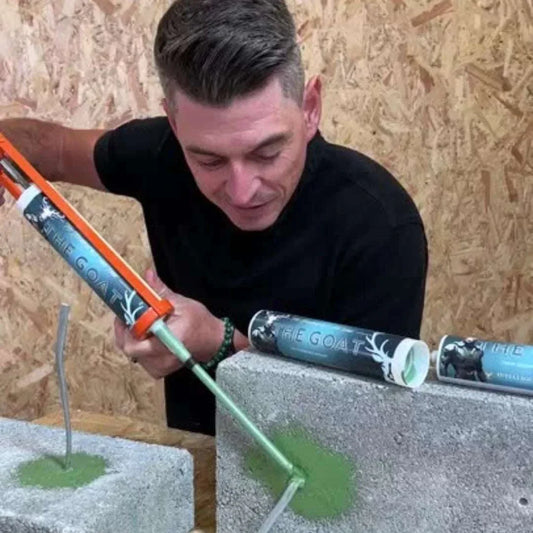
The GOAT sealant
A fast-curing reactive polymer applied by mastic gun, waterproof within one minute and curing to a flexible, airtight and waterproof seal. For internal corners, wall-to-floor junctions and transitions in wet rooms, before Poseidon goes on.
Passivhaus Brickseal
Breathable cream water repellent that cures within exposed masonry, repelling wind-driven rain while staying vapour-open and drying clear. See how to stop penetrating damp in brickwork.
Reinforcement and detailing
Corner band and mesh are embedded at junctions and crack-risk areas within The GOAT build-up; reinforcing tape or sealant is used under Poseidon. The reinforcement sits inside the membrane, not instead of it.
How much material should we allow?
| Product | Application | Coverage |
|---|---|---|
| Poseidon | Wet rooms, two coats required | 7 kg = 8.75 m²; 12 kg = 15 m² |
| The GOAT | All substrates, two coats | approx. 2.0 kg/m² (≈9 m² per 18 kg tub) |
Full figures are on the application and coverage rates page. Both Poseidon and The GOAT are two-coat systems and the published coverage already assumes both coats.

Has it been proved on real buildings?
At Reuben College, Oxford, Airtight White delivered basement airtightness on an award-winning scheme — a below-ground environment where sealing and waterproofing have to be considered together rather than as separate packages. Our best airtightness result on a school is 0.078 ACH at Wester Hailes High School, Edinburgh — a whole-building pre-test after our works, measured by EDP Building Sciences to ATTMA TSL4 in November 2025 against a 0.6 design target.
The certification record is the other half of the evidence, and it is deliberately specific: Poseidon's ETA-23/0378 with EN 14891 testing at Buildwise; The GOAT's ETA-25/0471 with its 25-year assessed working life. Those are documents that can be handed over, not claims taken on trust.
Can we see it on site before we specify it?
Inspect a completed application before committing to it. The 360° tours let a client-side team walk finished work and look at kicker joints, upstands, corners and penetrations as they were left; the video channel shows the roller, brush and pour sequences in real site conditions.
Frequently asked questions
Is a liquid DPM acceptable in place of a plastic sheet?
Waterproof Blue is designed as a liquid replacement for plastic DPMs and DPCs, applied by roller or brush in two crosswise coats and curing to a single monolithic layer with no laps or taped joints. It suits both horizontal and vertical applications.
What does the NHBC now require behind bathroom tiles?
Under NHBC Standards 2023, all bath and shower enclosures, wet rooms and bathroom pods must incorporate an impermeable liquid-applied waterproofing membrane behind tiled finishes — mandatory for NHBC-registered homes with foundations begun on or after 1 January 2024.
Can The GOAT be applied to a damp, cold substrate?
Yes — it applies to damp surfaces at 0 °C, where standard coatings typically need a dry substrate and 5 °C or above. That is why it suits UK groundworks.
Does an ETA mean the product is certified for my specific detail?
An ETA declares assessed performance for a defined product family and intended use — for Poseidon, watertight covering kits for wet room floors and walls (EAD 030352-00-0503); for The GOAT, liquid applied roof waterproofing kits (EAD 030350-00-0402). It only holds if the product is installed as assessed.
What standard applies to a habitable basement?
BS 8102:2022 is the code of practice for protecting below-ground structures against water from the ground; habitable space typically requires Grade 3, a dry environment. The waterproofing product is one part of that design, not the whole of it.
How do we detail the corners in a wet room?
The GOAT sealant is applied by mastic gun to internal corners, wall-to-floor junctions and transitions, becoming waterproof within one minute and curing to a flexible, airtight and waterproof seal. Poseidon then goes over the reinforced details and open areas as two cross-applied coats, before tiling with a suitable C2 cement-based adhesive.
Two ways to work with us on waterproofing
Supply. Buy the membranes, sealants and reinforcement and apply them with your own operatives or your groundworks, tiling or roofing subcontractor.
Supply and install. We apply the system ourselves. Send the drawings, the substrate and the exposure — below ground, wet room, balcony or roof — and we will come back with an approach and a price.
Supply — view the range Supply and install — talk to usShop Bathroom Waterproofing & Liquid DPM
-
Waterproof Blue Liquid DPM (10KG) - Roller applied liquid DPM
Short spec • 10.0 kg
Promotion -
Copagro Acrylic-DSP 310ml
Short spec • 420 g
-
Anti Oxidation Spray 400ml
Short spec • 560 g