Primers
Why prime at all, if the membrane bonds well?
Because it does not bond equally well to everything, and we publish the figures that show it. Pull-off adhesion to BS EN ISO 4624 gives 1.02 N/mm² on concrete and 0.75 N/mm² on plywood — strong, unambiguous bonds. It also gives 0.42 N/mm² on OSB, 0.24 N/mm² on gypsum sheathing and 0.04 N/mm² on wood fibre. Those last figures are the honest reason primers exist, and they are the substrates to raise before a specification is fixed rather than after the first pull-off test on site.
Independent testing at BBRI in Belgium and the University of Liège, reported in What does Passive Purple stick to?, adds an important qualification to how those numbers should be read. On several substrates the value is limited by the material, not the coating: on gypsum block, CLT, cement board and insulation the substrate failed internally before the bond did. A low number can mean a weak bond, or it can mean a weak surface — and the remedy is different in each case. A weak bond wants a key. A weak surface wants consolidating.
Three problems recur across UK substrates, and each has a different answer.
Suction and dust
Porous, friable and lime-based backgrounds pull water out of the coating as it cures and present a dusty surface the film cannot grip. The result is pinholing, uneven cure and a membrane that lifts.
No key
Dense concrete, power-floated slabs, smooth render and ICF give a coating almost nothing to mechanically grip. The membrane may look fine and still fail to develop full adhesion.
Finishes over the membrane
A cured liquid membrane is smooth and low-suction — excellent for airtightness, poor for plaster. Wet plaster, board adhesive and dot-and-dab need a mechanical key or you get hollow spots and debonded boards.

Which primer do I need on which substrate?
The table below is the short answer for the substrates that come up on UK sites. Where we cannot support a recommendation from our own published testing or guidance, the cell says so rather than guessing — send us the substrate and we will answer it specifically.
| Substrate | Primer | Coverage | Why |
|---|---|---|---|
| Dense concrete, power-floated slab | IM Primer | 0.15–0.25 kg/m² | Adhesion to concrete is high at 1.02 N/mm², but a dense, closed, power-floated face offers little key and often carries laitance. IM Primer strengthens and keys the surface. |
| Blockwork (dense aggregate and AAC) | IM Primer; Lime Prime where dusty or friable | 0.15–0.25 kg/m² | Block is absorbent and usually dusty. Priming regulates suction so the first coat cures evenly instead of being drawn into the block. |
| Brickwork, including existing brick on retrofit | IM Primer; Lime Prime on old, friable or lime-pointed brick | 0.15–0.25 kg/m² | Old brick and mortar are variable in absorbency and often chalky. Consolidate and even out the suction first. |
| Lime render and lime plaster | Lime Prime | 0.15–0.25 kg/m² | Lime surfaces are alkaline, porous and frequently friable. Lime Prime is formulated to bind and stabilise them, and is designed to work within breathable build-ups. |
| Cement render, smooth render | IM Primer | 0.15–0.25 kg/m² | Smooth render is the classic no-key surface. IM Primer provides the key the membrane needs. |
| OSB | Not normally required on sound, clean, dry board | — | Adhesion is 0.42 N/mm² to BS EN ISO 4624. Clean off dust and prepare the joints; the membrane is coating the board rather than relying on a tape at every joint. |
| Plywood | Not normally required on sound, clean, dry board | — | Adhesion is 0.75 N/mm² — one of the stronger board results in the set. |
| Plasterboard | Not normally required on sound, clean, dry board | — | Note separately that Approved Document L states internal plasterboard linings are not appropriate as an air barrier solution — see our internal airtightness page. |
| Gypsum sheathing board | Discuss before specifying | — | Adhesion is 0.24 N/mm², among the lower board figures. Where the paper face is friable or dusty, raise it with us before the specification is fixed. |
| Wood fibre board | Discuss before specifying | — | Adhesion is 0.04 N/mm² — the lowest figure we publish. Testing across insulation faces generally shows the board failing internally before the bond does, so treat this as a substrate strength question, not a coating question. |
| ICF and other smooth insulated formwork | Supergrip Primer | 0.2–0.3 kg/m² | The smooth ICF face is difficult for direct adhesion. Supergrip gives a textured, high-grip base — see the ICF and blockwork case study. |
| Galvanised steel | Not normally required on clean, degreased steel | — | Independent testing at BBRI and the University of Liège recorded 2.7 N/mm² on galvanised steel, the strongest bond in that set. |
| Cured Passive Purple or Airtight White, before plaster or dot-and-dab | Supergrip Primer | 0.2–0.3 kg/m² | The membrane surface is smooth and low-suction. Supergrip keys it so wet plaster and adhesive dabs bond instead of hollowing. |
| Existing painted surfaces | Send us the detail | — | We have no published test data for adhesion over existing paint systems, which vary enormously. Sound, well-bonded coatings and loose or unknown ones need different answers. |
What does each primer actually do?
IM Primer — for dense and smooth backgrounds
Dense concrete, power-floated slabs, smooth render and similar surfaces give a membrane very little to grip. Without a key, even a good airtight coating can fail to develop full adhesion or delaminate under stress — a hidden risk, because the airtight layer is usually behind a finish by the time anything shows. IM Primer strengthens and keys the substrate so the membrane has a sound surface to bond to. It is also the general-purpose choice for stabilising porous or dusty blockwork, brick, render and concrete, controlling suction before the first coat. Coverage is 0.15–0.25 kg/m². The background is in priming dense substrates before airtight membranes.
Lime Prime — for lime and porous backgrounds
Lime plaster, old masonry, AAC blockwork and other porous substrates pull moisture out of a coating as it cures and leave a dusty, friable surface a membrane cannot grip reliably. Skip priming and the risks are pinholing, poor adhesion and a membrane that lifts — exactly what you do not want in an airtight layer. Lime Prime consolidates the dust, binds the surface and regulates absorption so the membrane cures evenly onto something sound. It is formulated to work within breathable build-ups, which matters on heritage and lime-based construction where the wall must keep its drying path. Coverage is 0.15–0.25 kg/m². See priming porous and lime substrates.
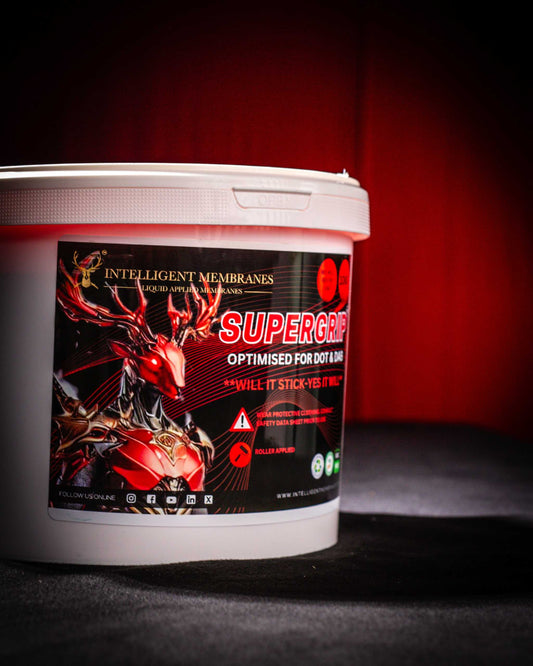
Supergrip Primer — for smooth surfaces and for plaster over the membrane
Supergrip does two jobs, and it is worth separating them. First, it primes smooth, low-suction substrates such as ICF so the membrane bonds properly: on the ICF and blockwork build in our case study, Supergrip was roller-applied across the ICF faces to give Passive Purple a textured, high-grip base before the airtight coat went on, with the blockwork coated directly. Second — and this is the more common use — it goes on over the cured membrane, before plastering. A cured liquid membrane is smooth by design; plaster, board adhesive and dot-and-dab can struggle to bond to it, and the failure shows up as hollow spots, debonding boards and cracked plaster after the finish is on and expensive to put right. Supergrip gives that surface a mechanical key. Coverage is 0.2–0.3 kg/m². See getting plaster and dot-and-dab to stick to airtight membranes.

Where does priming sit in the sequence?
Priming is one step of five, and the other four decide whether it works. The order that we see succeed on site is consistent.
Clean. Remove dust, grease and loose material. No coating bonds well to a poorly prepared wall, and on an airtight layer a bond failure becomes a leak path rather than a blemish. Make good. Pre-fill large gaps and repair friable areas before anything liquid goes on — a primer consolidates dust, it does not rebuild a wall. Prime. Lime Prime for porous and lime backgrounds, IM Primer for dense and smooth ones, Supergrip for smooth ICF. Detail. Tape frames and board joints, seal penetrations and junctions while access is easy. Coat. Apply the membrane in two full coats to a sound, consistent surface.
That last point carries more failed air tests than any primer choice. The certified performance depends on reaching the specified dry film thickness, and that takes two coats — the first evens out the substrate's suction, the second builds thickness and closes any pinholes the first pass left. Visual coverage is not film thickness. The full sequence is in how to prep a wall for an airtight coating, and the application detail in the Passive Purple application FAQ.

Which products are in the range?
IM Primer (10 kg)
- Coverage 0.15–0.25 kg/m²
- Dense concrete, power-floated slabs, smooth and cement render
- Also stabilises porous or dusty blockwork, brick and concrete
The general-purpose substrate primer before an airtight or vapour control membrane.
Lime Prime (10 kg)
- Coverage 0.15–0.25 kg/m²
- Lime plaster and lime render, old masonry, AAC blockwork
- Binds dust, regulates absorption, designed for breathable build-ups
The primer for heritage, lime-based and highly porous backgrounds.
Supergrip Primer (10 kg, roller)
- Coverage 0.2–0.3 kg/m²
- Key for plaster and dot-and-dab over a cured membrane
- Primer for smooth ICF and similar low-key surfaces
The high-grip key, used both under the membrane and over it.
Adhesion, BS EN ISO 4624
- Concrete 1.02 N/mm²
- Plywood 0.75 N/mm²
- OSB 0.42 N/mm²
- Gypsum sheathing 0.24 N/mm²
- Wood fibre 0.04 N/mm²
Published in full. The low figures are the reason this page exists.
View the primer range Application and coverage rates

Has it been proved?
On a luxury residential build combining insulated concrete formwork with traditional blockwork, the smooth ICF face was the adhesion risk. Supergrip Primer was roller-applied across the ICF surfaces for consistency, then Passive Purple was applied over both the primed ICF and the blockwork to form one continuous airtight barrier — the primer removing the weak point rather than the membrane being asked to cope with it.
The wider results follow from the same discipline. Our best airtightness result on a school is 0.078 ACH at Wester Hailes High School, Edinburgh — a whole-building pre-test after our works, measured by EDP Building Sciences to ATTMA TSL4 in November 2025, against a 0.6 design target. On projects we supply and install, we guarantee 0.6 ACH or lower. On existing brickwork the membrane has been applied directly over the old wall as a continuous seal — the kind of variable, absorbent background where the primer decision is made before anything else.
Supergrip on ICF and blockwork Wester Hailes — 0.078 ACH Retrofit sealing on brickwork
See it on site
Priming is the step that is easiest to skip and hardest to inspect afterwards, so it is worth looking at how it is done. The 360° tours let you walk completed applications; the video channel shows primer and membrane going on in sequence.
360° site tours Application videos Technical details and drawings

Frequently asked questions
Dense or porous — which primer do I use?
IM Primer for dense and smooth surfaces such as concrete, power-floated slabs and smooth render. Lime Prime for porous, dusty, friable and lime-based backgrounds. Supergrip Primer for smooth ICF, and over a cured membrane before plastering.
Can I skip priming altogether?
Only on sound, suitable substrates — clean, dry OSB, plywood and plasterboard generally do not need it. On marginal, dusty or dense backgrounds it is cheap insurance against an adhesion failure you cannot inspect later. When in doubt, prime.
Can I plaster straight onto Passive Purple without a primer?
A primer is strongly recommended. The cured membrane is smooth and low-suction, so plaster and dot-and-dab adhesive need Supergrip Primer to give them a mechanical key, or you risk hollow spots and debonding after the finish is on.
How much primer should we allow?
Supergrip Primer covers 0.2–0.3 kg/m². Lime Prime and IM Primer each cover 0.15–0.25 kg/m². Figures vary with substrate porosity and application method; full figures for every product are on the application and coverage rates page.
Does priming affect breathability?
Lime Prime is designed to work within breathable build-ups, which is why it is the primer specified on lime and heritage substrates. For a specific build-up, check the product datasheet for the system you are using.
Why publish the low adhesion figures?
Because they are the ones that change a specification. 0.04 N/mm² on wood fibre and 0.24 N/mm² on gypsum sheathing are conversations to have before the drawings are issued. Independent testing also found that on several substrates the material failed before the bond did — so a low figure can describe the surface rather than the coating.
Two ways to work with us
Supply. Buy the primers and membranes and apply them with your own operatives or your contractor. Tell us the substrates and we will confirm the primer and the quantities.
Supply and install. We prepare, prime and apply the system ourselves, and on projects we install we guarantee 0.6 ACH or lower. Send the substrates, the drawings and the target, and we will come back with an approach and a price.
Supply — view the primer range Supply and install — talk to us